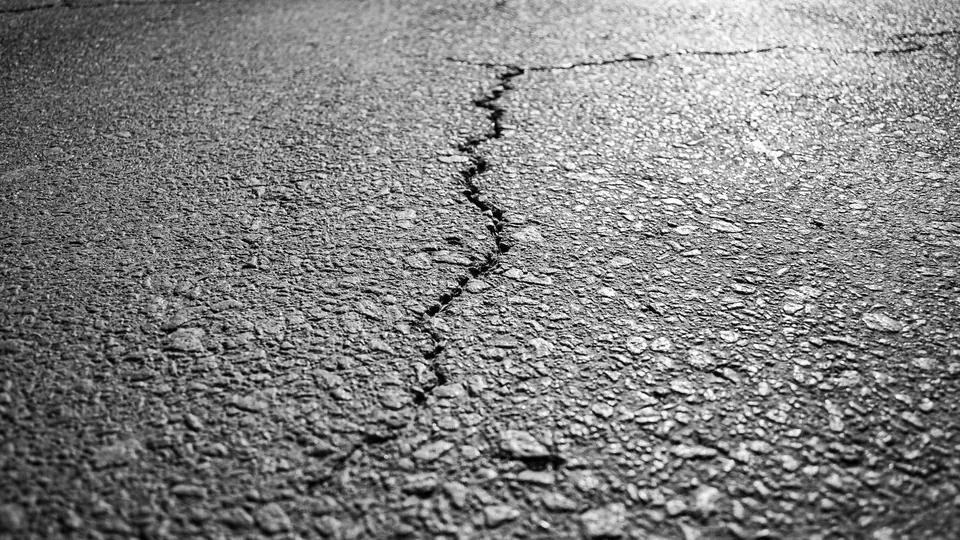
Reading the damage
Different cracks mean different things, and the pattern tells you what is happening below.
Single straight cracks running roughly the length of the drive are usually shrinkage or a joint from the original construction. They are surface-level, they are the easiest thing on this page to deal with, and sealing them early is one of the highest-value maintenance jobs there is.
Cracks running across the drive, perpendicular to traffic, often come from thermal movement or a reflected joint from something buried underneath. Also generally sealable, though the reflected kind will keep coming back.
Curved cracks near an edge, sometimes with a slight drop, mean the edge is unsupported and the asphalt is breaking away because nothing is holding it up laterally. Sealing that is treating the symptom.
Alligator cracking — the interconnected web that genuinely looks like reptile skin — is the one that matters. It means the base beneath has lost strength and is flexing under load, and the surface is failing from fatigue. It cannot be sealed, it cannot be patched thin, and paving over it produces the same pattern coming back through within a season or two. That is a removal-and-rebuild of the affected area.
And a crack that lifts along a line, often with the surface humped slightly, is very often a tree root. Around Charleston that means a live oak more often than not, and the fix has to deal with the root or the crack simply returns.
Crack filling and why timing beats technique
Crack filling is the cheapest meaningful thing a property owner can do, and the value is almost entirely in doing it before the wet season rather than after.
The threshold that matters is roughly a quarter of an inch. Below that, a good sealcoat generally bridges it. At or above it, the crack is an open channel into the base, and every rain sends water down it.
The work itself is straightforward: clean the crack out properly so the filler bonds to asphalt rather than to dirt and grass, then fill it with a material that stays flexible. Rigid filler in a crack that moves seasonally just cracks again down the middle. The cleaning step is the one that gets skipped and it is the one that decides whether the repair holds.
Charleston is rain-driven rather than freeze-driven, which changes the priority slightly from what you read in national guidance. In colder climates the urgency is water freezing in the crack and levering it wider. Here the urgency is volume — long soaking rain and tropical systems putting a great deal of water through the same opening, into a base that is already sitting close to the water table.
Potholes, and why the cheap patch does not last
A pothole is what happens after water has been in the base for a while. The support underneath is gone, traffic breaks the unsupported surface, and material starts ejecting.
Cold patch — the bagged material shovelled in and tamped — is a genuinely useful thing when you need a hazard gone this afternoon. It is a temporary repair and should be described as one. It does not bond well, it does not restore structure, and it works its way out.
A repair meant to last is a saw-cut patch. The failed area is cut back to sound asphalt in clean square edges, the material is removed, the base underneath is inspected and corrected, and new asphalt is laid in and compacted. Square edges matter: a feathered or irregular edge has no thickness where it meets the existing surface and fails there first.
The step that separates a real repair from an expensive temporary one is the base inspection. If the hole formed because the base is wet and soft, filling the hole with asphalt puts a new lid over the same problem. The soft material has to come out.
And if potholes are appearing in several places across one surface, that is usually not several independent repairs. That is a surface reaching the end of its life, and at some point the arithmetic favours replacing the area rather than patching it repeatedly.
Depressions, ponding and the drainage repairs nobody quotes
A low spot that holds water after rain is both a symptom and a cause. Something settled to create it, and now that spot receives more water than anywhere else on the surface, which accelerates whatever is happening underneath.
On ground this level, with next to nothing in the way of a working gradient, standing water is common enough that its presence alone does not condemn the job — plenty of sites have nowhere for it to go. It still needs answering, though, because the alternative is ground that never dries out beneath the surface.
The repair depends on the cause. A settled area over a soft pocket needs the pocket dealt with, not just filled. A surface that was never given adequate fall may need a levelling course, or in a bad case regrading. Sometimes the real answer is not on the asphalt at all — a trench drain at the low end, a swale, or fixing where a downspout discharges.
The diagnostic worth doing is free: go out during a heavy rain and watch where the water actually goes. Five minutes of that answers questions no amount of looking at a dry surface will.
Root damage, which is its own category here
Live oak roots deserve their own section because in this part of South Carolina they cause more driveway damage than almost anything else, and because the usual fix is wrong.
The roots run shallow and laterally, well beyond the spread of the branches. When one runs under a paved surface it grows and lifts, and the asphalt cracks along the line above it. Removing the damaged asphalt and laying new asphalt over the same live root produces the same crack in the same place, usually within two seasons.
Real options are cutting the root and installing a physical root barrier so it does not simply regrow into the same space, rerouting the paved area around it, or deciding to treat that section as recurring maintenance and budget for it.
Which of those is available is not purely a paving question. Many of these trees are protected under local ordinance, and cutting significant roots can both violate the rules and endanger a tree that is worth considerably more than the driveway. That gets checked before a saw comes out.
Repair, resurface, or replace — the honest arithmetic
There is a point where repairing stops making financial sense, and it is worth naming plainly rather than discovering it after the third patch.
Repair is right when the failures are isolated and the rest of the surface is sound. Fix them, seal the surface, and get years out of it.
Resurface is right when the surface as a whole is worn, oxidized, and cracking, but the base is stable and the drainage works. A new layer over a sound base is excellent value.
Replace is right when the base has failed. Widespread alligator cracking, multiple soft or flexing areas, ponding that keeps returning after repair. At that point every dollar spent on the surface is a dollar spent on a lid.
A useful rule of thumb: when the area needing repair approaches roughly a quarter to a third of the total surface, get a price on resurfacing or replacing before committing to the patches. The patch bill on a failing surface has a way of quietly exceeding the cost of doing it properly once.
Request a free written quote
Tell us the address and what you are looking to have done. Ask for the quote in writing with the thickness and the base work spelled out, so you can compare bids on the same terms.
Prefer to talk it through? Call (843) 594-0781.
Asphalt repair FAQ
How do I know if my driveway needs repair or replacement? Look at whether the problem is on top or underneath. Isolated cracks and potholes in an otherwise solid surface are repairs. A worn, oxidized, surface-cracked driveway on a stable base is a resurface. Interconnected alligator cracking, areas that flex when a car rolls over them, and water that keeps standing after it has been fixed all point at a failed base, and that is a replacement. Paving over a failed base returns the same pattern within a season or two.
Is cold patch worth using on a pothole? For getting a hazard out of the way today, yes, and there is no shame in it. As a permanent repair, no. Cold patch does not bond well to the surrounding asphalt and does not restore any structure underneath, so it works loose over time. A repair meant to last is cut back to sound material in square edges, the base beneath is corrected, and new asphalt is compacted into the opening.
When should cracks be filled? Once they are wider than about a quarter of an inch, and ideally before a wet stretch rather than after one. Below that width a good sealcoat generally bridges them. Above it, the crack is an open route into the base, and around Charleston the risk is the sheer volume of water a long rain or a tropical system can put through one opening into ground that is already close to saturated.
Why does water stand on my driveway after every rain? Either the surface never had enough fall to shed it, or something settled and created a low spot. Both matter, because ponded water is the fastest way to ruin what is underneath. On flat Lowcountry lots there is often very little natural grade available, so the fix is sometimes a levelling course or regrading and sometimes a drain, a swale, or moving where a downspout discharges. Watching where the water goes during an actual downpour is the most useful diagnostic there is.
Can a repair be matched to the colour of the rest of the driveway? Not exactly, and it is better to expect that up front. New asphalt is black and existing asphalt has oxidized to grey, so a patch will be visible. It blends over months as the new material weathers. If appearance matters, sealcoating the whole surface after the repairs have cured is what makes it read as one driveway again rather than a patchwork.
The same crack keeps coming back after every repair. Why? Because whatever is causing it is still there. A crack that returns in the same line is being driven from below, and the two usual causes here are a tree root running under the surface and a soft spot in the base flexing under load. Both need to be addressed at the source. A recurring crack is telling you something useful — it is worth reading rather than refilling.