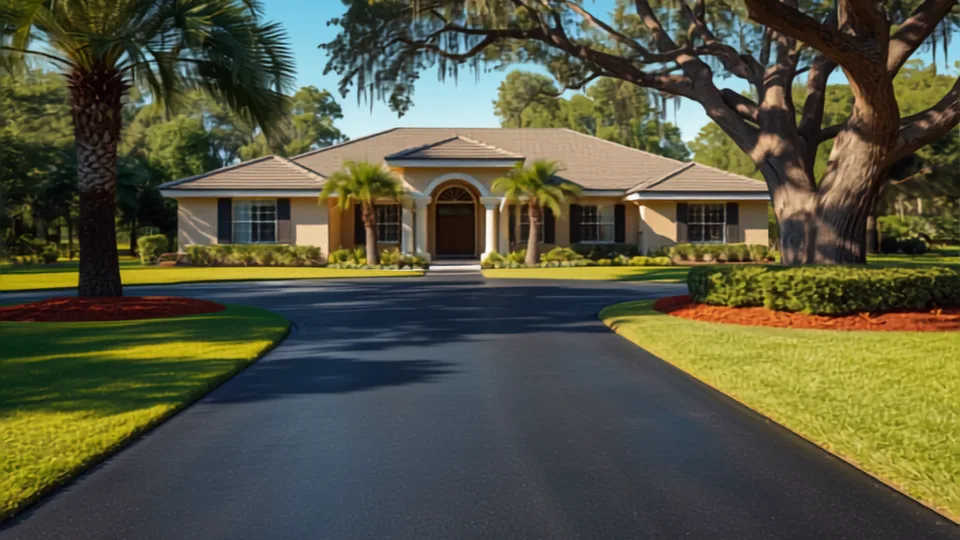
Deciding what you actually need
Most driveway calls fall into one of four situations, and knowing which one you are in changes every conversation that follows.
The first is a driveway that has never been paved — gravel, shell, dirt, or grass ruts. This is the cleanest version of the work because everything gets built correctly from the ground up, and it is also where the finished result is most predictable.
The second is a surface that looks tired but is still holding together. Grey rather than black, a little rough underfoot, maybe some hairline cracking, no dips and no soft spots. That driveway usually wants a resurface, not a replacement, and treating it as a replacement is money spent early for no additional life.
The third is a driveway that has started to come apart in specific places — a pothole at the apron, a corner that has crumbled, cracks wide enough to put a finger in. Those are repairs, and a repair done properly stops the failure spreading. Water getting into a crack and then into the base is how a small problem becomes a whole driveway.
The fourth is a driveway that is failing structurally. Alligator cracking, sections that flex when a car rolls over them, water standing after every rain. That one needs to come out. It is the most expensive answer and the only one that lasts.
What install day looks like
Knowing the sequence makes it much easier to tell whether the crew on your property is doing the job you paid for.
The old surface comes out first, if there is one, and gets hauled away. Then the subgrade gets shaped — this is where the fall is set, and where any soft ground gets found. If soft material turns up, it gets dug out and replaced with stone rather than paved over.
Stone base goes down next and gets compacted, generally in more than one lift. A base laid in a single deep layer cannot be compacted properly through its full depth, no matter how many passes the roller makes. This step is the one that is invisible a week later and decisive a decade later.
Then the asphalt is delivered hot, spread, and rolled while it is still hot enough to compact. Timing matters — asphalt that cools before it is compacted will never reach full density, and low density is a surface that ravels and lets water in. On a hot Charleston afternoon there is a comfortable working window. On a cool damp morning in January it is tighter.
Edges get shaped, the transitions at the street and the garage get tied in, and the drive is closed off while it sets. The whole thing on a typical residential drive is usually a day, sometimes two if there is significant base work or the weather interrupts.
Edges, aprons and the places driveways fail first
Damage almost never starts in the middle. It starts at an edge, and the reasons are worth understanding before you sign anything.
The unsupported edge is the most common. Asphalt has no strength at a free edge, so when a wheel runs off the side it breaks away, and once the edge is broken water gets into the base from the side. Sloped or backfilled edges, or a defined shoulder, are how that is handled. On a narrow drive where people habitually cut the corner, this is not cosmetic.
The apron — where the driveway meets the street — takes the heaviest and most repeated loading on the whole property. Every vehicle crosses it, often turning, and delivery trucks land on it. It also sits at the low end where runoff concentrates. Aprons want extra thickness and a clean tie-in, and where the county or municipality owns the right of way, what can be done there is not entirely your decision. That is worth checking before the work is scheduled rather than after.
The garage transition is the third one. If the drive settles even slightly away from the slab, water runs back toward the building instead of away, and a seam opens for it to get under the surface.
Charleston-specific things that shorten the life of a driveway
Live oak roots are the local signature problem. They travel shallow and spread much further than the canopy suggests, and a root running under asphalt lifts it until the surface cracks along the line of the root. The options are cutting the root and installing a barrier, routing the drive around it, or accepting that section as ongoing maintenance. Several of these trees are protected, so what is allowed gets confirmed before anything is cut.
Standing water is the second. On flat lots with a high water table and very little natural fall, getting water off the surface and away from the base takes deliberate design. A puddle that sits after rain is marking the spot that will fail first.
Sun is the third and it is unglamorous. Ultraviolet exposure oxidizes the binder that holds the aggregate together. The surface stiffens, then starts releasing stone, then lets water in. That process runs faster here than in most of the country, which is why maintenance timing matters more than homeowners expect.
And for properties near the marsh or in the flood-prone parts of the peninsula and the islands, periodic salt water in the base is a real consideration. It is not a reason to avoid asphalt. It is a reason to be honest in the design about how often water reaches the site and where it goes afterward.
Keeping it once you have it
A driveway that gets basic attention outlasts a neglected one by years, and the routine is short.
Put a coating on it in the second or third year after the last one, and resist anybody selling you an annual visit. The film has a job — shading the binder and shrugging off spills — and it can only do that job if it is the right thickness. Stack coats faster than they wear and you end up with a hard, glassy skin that fractures under its own rigidity.
Deal with splits once they are wide enough to catch a fingernail, and get to them ahead of a wet spell rather than behind one. At that size it is an afternoon with a caulking wand. Left through a couple of soggy winters, the same split has quietly drowned the ground beneath and turned into structural work.
Do not let the drive become a dam. Turf and silt march inward from the verges and quietly build a lip that traps runoff against the asphalt; a spade once a year keeps that from happening. Point roof water somewhere other than the parking area while you are at it.
Mind anything that stands on one leg. A caravan leg, a bike prop or a skip wheel funnels a great deal of mass through an area the size of a coin, and the surface is at its most yielding precisely when the weather is at its worst for it. Something flat underneath solves it for nothing.
And do not use the driveway as a place to park something heavy and stationary for months. Constant load in one footprint on a hot surface is how permanent depressions form.
Comparing bids without guessing
Three bids for a driveway can differ by thousands and every one of them can be honest, because they are not describing the same job. Get each to state the same four things and the comparison becomes real.
Compacted asphalt thickness. Base material and compacted base thickness. Total square footage. And what happens to the water.
Then ask each contractor what they will do if the base opens up softer than expected, and whether that is included, an allowance, or a change order. The answer tells you a great deal about how the rest of the job will go.
Nobody produces a genuine figure down a telephone line, and anything offered that way will shift once somebody has actually walked it. Get the document after the visit, with depths and ground works itemised, so three of them can sit on the table and be read as three versions of one job.
Request a free written quote
Tell us the address and what you are looking to have done. Ask for the quote in writing with the thickness and the base work spelled out, so you can compare bids on the same terms.
Prefer to talk it through? Call (843) 594-0781.
Asphalt driveways FAQ
How much does an asphalt driveway cost in Charleston? The answer lives in details only visible on the ground, which is why anyone serious declines to quote it down the line. What swings the figure is how machinery reaches the work, whether something existing must be broken out and carted off, how much putting right the ground beneath needs, the finished depth, and what must be constructed so runoff can escape. An open run with decent fall and nothing to demolish sits at the bottom of the range; a cramped plot over collapsed ground with water sitting on it does not.
How long will an asphalt driveway last here? Expect somewhere between fifteen and twenty years if what sits underneath was done properly, occasionally more. Somewhere cool and dry the same construction would give you longer, and the reason it does not here has little to do with how many cars use it. Sunlight works on it from one side and moisture from the other. If you want to move that number, move the water — drives that shed it cleanly last years longer than drives that hold it, whatever was spent on the black part.
Can I widen an existing driveway with asphalt? Yes — it comes up constantly on properties laid out when one car per household was the assumption. The added strip gets built the same way any fresh work does, from the ground upward. What determines whether it ages as one driveway or two is the line where the addition meets what was already there. Cut the old edge square rather than tapering it, and close the seam once everything has hardened, or that line becomes the way water gets underneath both halves.
Will a new driveway need approval from my HOA? Often, in the newer neighbourhoods around Mount Pleasant, Daniel Island and Summerville. Some associations restrict surface material, colour, or the extent of hardscape a lot may carry, and some require plans before work starts. It is worth checking early because it can affect what gets quoted, and on the historic parts of the peninsula there can be additional review that has nothing to do with an HOA.
What is the black liquid that came to the surface after paving? Occasional shiny patches where liquid asphalt has risen to the surface are usually cosmetic and settle as the drive cures. Widespread tackiness, footprints that stay, or a surface that stays soft weeks later is a different matter and worth raising with whoever did the work. Charleston heat keeps new asphalt soft longer than most guidance assumes, so give it time before deciding something is wrong — but do not ignore it indefinitely.
How soon can a new driveway be sealcoated? Not straight away. Fresh asphalt is still setting up and still driving off the lighter fractions in its binder, and that is a months-long process rather than a two-week one. Cap it too soon and you either lock the vapours in — producing a drive that never firms up — or you get a coating that lifts in sheets a season later. Treat the first application as a job for next year, not the final flourish on install day.