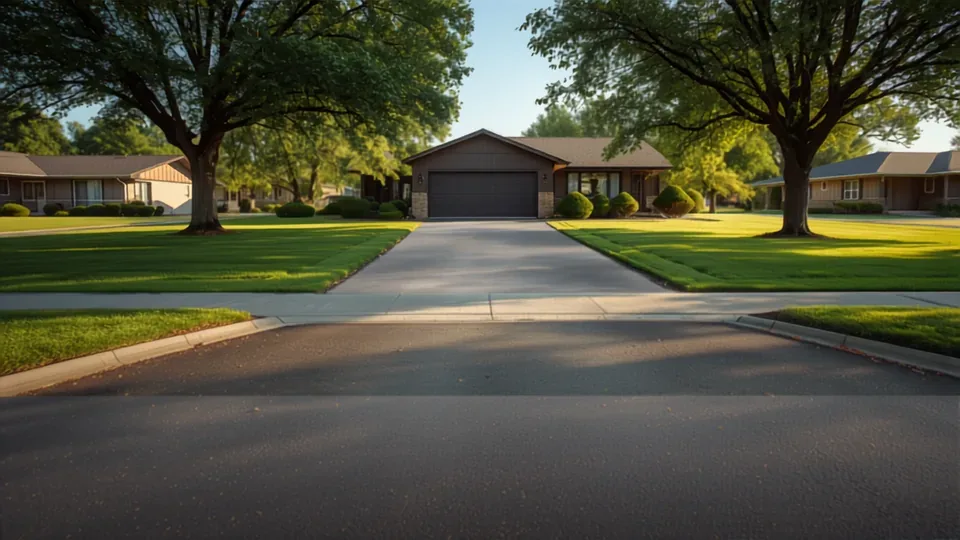
Driveways built for a different era
A mid-century driveway in this part of town was typically built narrow, thin, and on a light base, because that was adequate for the vehicles and the expectations of the time.
Modern vehicles are heavier and wider. A drive built for a mid-century sedan is being used by something considerably larger, and the most common consequence is edge damage — wheels running off the side of a surface that has no lateral support, breaking the edge away, and letting water into the base from the side.
Thickness is the second issue. Many of these surfaces have been overlaid once or twice already, which means the current driveway is a stack of layers of varying age and condition sitting on an original base that was never designed for what it now carries. Adding a third layer to that is a short-term answer.
Widening is one of the most common requests here, and it is usually worth doing at the same time as any resurfacing rather than later. The joint where new meets old wants a clean vertical cut on the existing edge, not a feathered tie-in, and it should be sealed once cured — otherwise that seam becomes the route water takes underneath.
The canopy, and roots that have had sixty years to travel
The trees are the reason people live here and the reason the driveways crack. Both are true.
Live oaks send roots laterally and shallow, well beyond the spread of the branches, and sixty or seventy years is a long time for a root to travel. Under a driveway they lift, and the surface cracks in a line directly above.
What makes West Ashley particular is how many of these driveways were laid before the trees reached full size. The tree was not a consideration in the original construction and now it is the dominant one. A crack that has appeared in the last decade on a driveway that was fine for forty years is very often a root that has only recently arrived under it.
Repaving over a live root returns the same crack, generally within a couple of seasons. The genuine options are a barrier installed after a permitted root cut, routing the paved area around the root zone, or treating that section as recurring maintenance and budgeting for it.
Many of these trees are protected, and cutting significant roots can endanger a tree worth substantially more than the driveway. What is permissible gets confirmed before anything is cut, not after.
Flat ground and water that has nowhere to go
Much of West Ashley sits low and flat, and parts of it are well known for holding water after heavy rain. That is a paving problem as much as a stormwater one.
On a lot with almost no natural fall, getting water off a driveway and away from the base takes deliberate design rather than a default slope. Where nothing on the lot offers an outlet, something has to be constructed to make one — a channel across the bottom edge, a shallow shaped depression carrying water off to the side, or reworking the levels of a strip of lawn so the paving stops being the lowest ground on the property.
A puddle that sits for more than a few minutes after rain is marking the place that will fail first. That water is not just on the surface; it is soaking into the base through every hairline it can find, and every vehicle that rolls over the spot pumps it around underneath.
The cheapest diagnostic available is standing outside during an actual downpour and watching where the water runs. Five minutes of that answers questions that a dry-day inspection cannot.
Gutter downspouts are worth checking at the same time. A downspout discharging onto or beside a driveway concentrates roof runoff exactly where it does the most harm, and rerouting it is one of the cheapest improvements a homeowner can make.
What sixty years of sun looks like
The other half of the ageing story is ultraviolet exposure, and on an old West Ashley driveway it is usually visible from the street.
Sunlight steadily degrades the glue in the mix. The material hardens, loses its colour, coarsens underfoot, and eventually stops holding onto its own stone — which is where the gritty feel and the small piles of loose chippings along the verges come from. The trade calls that raveling. Practically, it means the drive is slowly disassembling itself.
A driveway at that stage is past the point where sealcoating is protecting anything, because there is not much binder left to protect. Sealing a raveled surface is cosmetic and short-lived.
What it usually wants instead is resurfacing, assuming the base is still sound — and on many of these properties it is, because the ground settled decades ago and stopped moving. A worn surface on a stable base is one of the better-value jobs in paving.
The test remains the same one: is the problem on top or underneath? Grey, rough and surface-cracked can be resurfaced. Interconnected alligator cracking, dips, and areas that flex under a car cannot.
Access, and the practical side of an older neighbourhood
Older streets bring some practical constraints that are worth raising during an estimate rather than on the morning of the work.
Low branches over the driveway can genuinely limit which equipment can get in. That is often solvable with trimming, but trimming a protected tree is not a decision to make casually and may need approval.
Narrow streets, on-street parking and shared drives affect where trucks can stage and where material can be delivered. On a tight approach some of the work may need to be done by hand, which changes the timeline and the price.
Soft shoulders and shallow ditches at the road edge matter too — a loaded truck parked on a soft verge causes its own damage, and where it can safely sit is worth agreeing in advance.
None of this makes a job difficult. It makes it a job that should be looked at in person before a number is given, which is true of paving generally and unusually true here.
Request a free written quote
Tell us the address and what you are looking to have done. Ask for the quote in writing with the thickness and the base work spelled out, so you can compare bids on the same terms.
Prefer to talk it through? Call (843) 594-0781.
West Ashley paving FAQ
My driveway is grey and shedding gravel. Does it need replacing? Not necessarily. That texture is raveling — the sun has broken down the binder and the surface is releasing its aggregate. If the base underneath is still solid, which it often is on older properties where the ground settled long ago, the answer is resurfacing rather than replacement. What rules out a resurface is evidence the base has failed: interconnected alligator cracking, dips, and areas that flex when a car rolls over them.
Is sealcoating worth it on a driveway this old? It depends entirely on how much binder is left. On a surface that is still reasonably intact, sealcoating is genuinely useful and slows further ultraviolet damage. On a surface that is already raveling and shedding stone, it is cosmetic and short-lived, because there is little left to protect. In that case the money is better spent on resurfacing, and sealing the new surface a season later.
Water stands on my driveway every time it rains. What can be done? One of two things: the drive was never built with enough tilt to move water off, or a section has dropped and made a basin. Around here the land gives you very little to work with either way. Remedies range from building the level back up or reshaping the fall, through to putting in something that physically collects and carries water away. Check the roof drainage while you are at it — a downpipe emptying beside the parking area delivers an extraordinary volume to precisely the wrong place.
Can my driveway be widened? Very commonly, and most of the housing stock around here was laid out for cars a good deal narrower than what people drive now. Building the extra width is ordinary new work. The part that decides whether you end up with one driveway or two glued together is how the old edge is treated where the addition lands against it — squared off rather than tapered, and closed up once cured. Get that wrong and the join is where everything starts coming apart.
The crack over the tree root keeps coming back. Is there a permanent fix? Only if the root is dealt with, and what is allowed depends on the tree. Repaving over a live root returns the same crack in the same line within a couple of seasons. Real options are a barrier installed after a permitted root cut, routing the paved area around the root zone, or accepting that section as recurring maintenance. Many of these oaks are protected, so what can legally be cut is established before any work is planned around it.