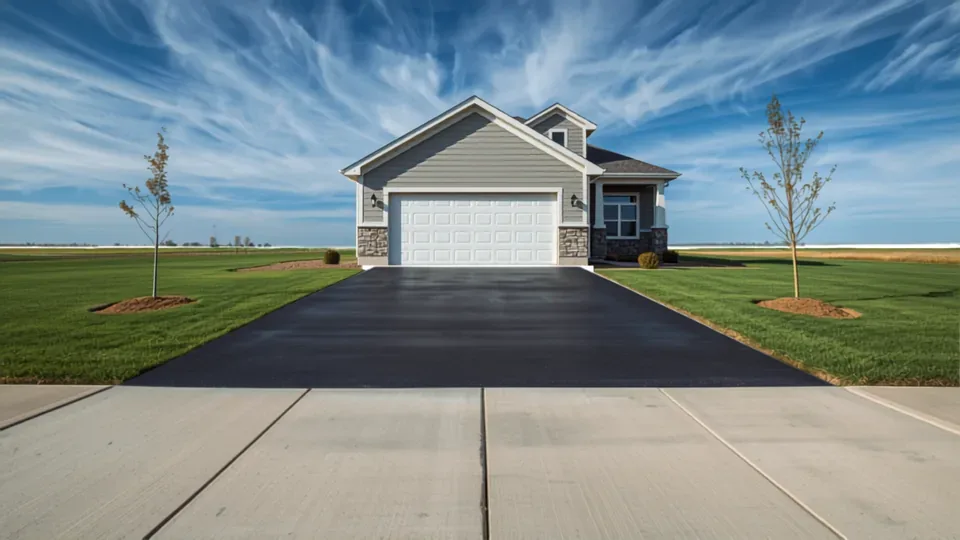
Clay, and what it does to a driveway
Clay soils expand when they take on water and contract when they dry out. That is not a subtle effect — it is enough movement to lift and drop whatever is sitting on top, repeatedly, season after season.
For a rigid surface that cycle produces cracking, because rigid material has nowhere to go. Asphalt handles it better because it flexes, which is a genuine argument for asphalt on this kind of ground. But flexing is not the same as immunity. Repeated movement still fatigues a surface, and it will find the weakest point.
The defence is base depth and drainage. A properly compacted stone base spreads load and buffers movement, and keeping water away from the clay reduces how much it swells in the first place. On clay, base thickness is not the place to economise — adding asphalt over an inadequate base is spending money on the wrong layer.
Clay also drains slowly, which changes what happens after a heavy rain. Water that would soak away on a sandy lot sits, and sitting water is what softens the subgrade under the base. Where the runoff goes matters more here than the slope of the driveway itself.
New construction and the settling that follows it
A great deal of Summerville housing is recent, and a great deal of it sits on ground that was reshaped during development. That has a predictable consequence.
Fill placed during construction continues to consolidate for years afterwards. A driveway laid on ground that is still settling can develop dips and low spots that have nothing to do with the quality of the paving. Utility trenches are the classic version — the ground over a trench settles differently from the ground beside it, and a line appears across the driveway following exactly where the pipe runs.
On a very new build there is a case for waiting, or for accepting that a first surface may need attention sooner than a driveway on ground that settled decades ago. Neither is bad news, but both are better known in advance than discovered.
The other new-construction pattern worth naming is the builder driveway. Driveways installed as part of a housing package are frequently built to the minimum that will pass — thin, on a light base, on ground that had a lot of equipment across it. They can look perfect for three or four years and then deteriorate quickly. When a five-year-old driveway in a newer neighbourhood starts alligatoring, that is usually what happened.
Long drives, side loads and the way suburban lots are shaped
Driveways here tend to be longer than in the older parts of the region — deeper setbacks, side-entry garages, turnarounds, and a fair number of properties with a second parking area for a boat or a trailer.
More area means more of everything: more drainage to plan, more surface exposed to the sun, and a larger difference in the final number between a bid quoting two inches compacted and one quoting three. On a short drive that difference is modest. On a long one it is substantial, which is exactly why bids should be compared on stated compacted thickness rather than on the total.
Anywhere vehicles pivot rather than roll — turning heads, side-entry approaches — is punished harder than a straight run. A wheel dragged sideways tears at the surface instead of simply pressing on it. Those spots deserve the same reinforcement a commercial entrance would get.
Boat and trailer parking deserves a specific mention. A tongue jack concentrates enormous weight into a footprint the size of a saucer, and asphalt is softest exactly when it is hottest. A pad, a plate, or even a piece of plywood under the jack prevents a permanent dimple.
Pines, oaks and root behaviour inland
The tree mix shifts as you move inland, and so does the root problem.
There are still live oaks here, and they behave the way they behave everywhere in the Lowcountry — shallow, wide-spreading roots that lift pavement and crack it along the root line.
Pines are more common in the newer subdivisions, and their root systems tend to run somewhat deeper than a live oak is, which makes them less likely to lift a driveway directly. What they do instead is drop needles and organic debris that block drainage paths and hold moisture at edges, and they shed limbs.
Either way, the practical advice is the same: keep the edges clear. Soil, needles and grass creeping over the edge of a driveway dam the runoff, hold water against the asphalt, and give the edge somewhere to fail. Cutting the edges back is unglamorous and one of the highest-value things a homeowner can do.
Timing the work around Summerville weather
There is very little of the year when paving is off the table here. The material wants ground that is reasonably warm and getting warmer, and this area supplies that across most of the calendar — the winter shutdown that governs the trade further north simply does not apply.
Rain is the actual constraint. A saturated base cannot be paved, and clay holds water longer than sand does, so the ground here can need more drying time after a wet stretch than a coastal lot would. A crew postponing after heavy rain is doing the right thing, even when the surface looks dry.
Summer afternoon storms are the scheduling hazard for anything that needs a dry cure — sealcoating especially, which needs the surface to stay dry through cure and can be ruined by a storm arriving a few hours after application. Spring and autumn generally offer steadier windows.
Hurricane season is worth keeping in view for larger projects, less because of the storm itself and more because of the several days of saturated ground that follow one.
Request a free written quote
Tell us the address and what you are looking to have done. Ask for the quote in writing with the thickness and the base work spelled out, so you can compare bids on the same terms.
Prefer to talk it through? Call (843) 594-0781.
Summerville paving FAQ
Why do driveways in newer Summerville neighbourhoods fail early? Two reasons that often overlap. Ground reshaped during development keeps consolidating for years, so a surface laid on it can develop dips that are nothing to do with the paving. And driveways installed as part of a housing package are frequently built to the minimum — thin asphalt on a light base, over ground that had heavy equipment across it. That combination looks fine for a few years and then deteriorates fairly quickly.
Does clay soil mean I need a thicker driveway? Usually it means a thicker base rather than thicker asphalt. Clay expands and contracts with moisture, and a properly compacted stone base spreads load and buffers that movement. Adding asphalt over an inadequate base is spending on the wrong layer. Keeping water away from the clay in the first place matters just as much, which is why the drainage plan is part of the design rather than an afterthought.
There is a line across my driveway following a pipe. What is that? Almost certainly settlement over a utility trench. Ground that was excavated and backfilled consolidates differently from the undisturbed ground beside it, so a depression or crack appears directly along the line of the trench. It is common on newer construction. The fix depends on how much movement is still happening — sometimes a levelling repair is enough, sometimes the area needs rebuilding once the ground has finished settling.
Can I park a boat or camper on an asphalt driveway? Yes, with one precaution. Tongue jacks and stabiliser feet concentrate a great deal of weight into a very small footprint, and asphalt is at its softest when it is hottest. A jack pad, a steel plate or even a scrap of plywood spreads that load and prevents a permanent dimple. The same applies to motorcycle kickstands and to trailer legs left down for weeks at a time.
How long should I wait before sealcoating a new driveway? Several months, not weeks. New asphalt has to cure and release its lighter oils before it will accept a coating properly, and sealing over that traps them, which can leave a surface that stays soft or peels later. The first seal is a next-season job. After that, every two to three years is the right cycle — annually builds a brittle film that cracks on its own.