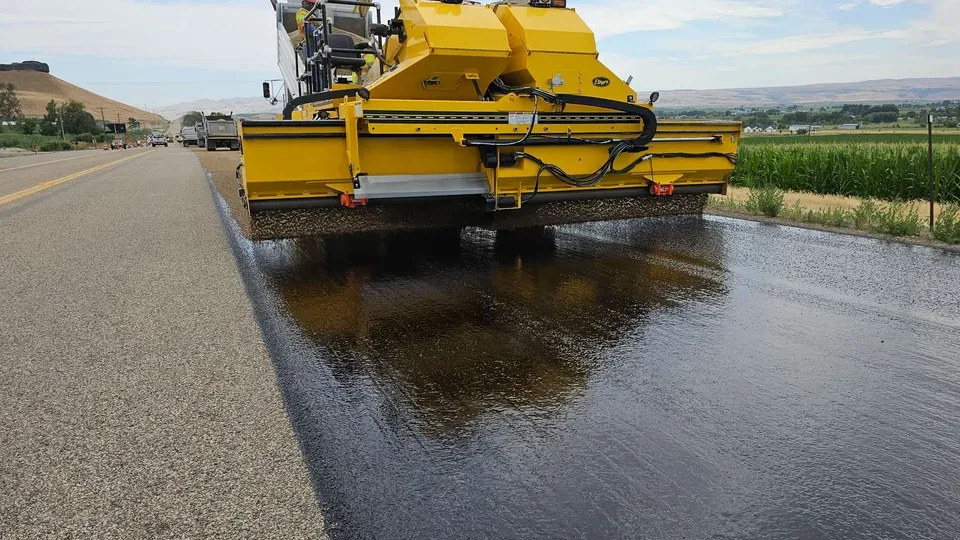
What actually goes into an asphalt surface
An asphalt surface is three things stacked: a prepared subgrade, a compacted stone base, and the asphalt itself. Homeowners see the last one and price the job on it, which is exactly why so many cheap bids look competitive on paper and fail early.
The subgrade is the native ground. Around Charleston that ranges from clean sand on the barrier islands and parts of Mount Pleasant, to heavy clay lenses inland toward Summerville and Ladson, to soft organic soils near the marsh edge. Sand drains beautifully and compacts poorly. Clay holds water and swells. Neither is a base on its own, and the answer is different from one street to the next — sometimes from one end of a driveway to the other.
On top of the subgrade goes the aggregate base, usually a graded crushed stone laid and compacted in lifts. This is the layer that carries the load and spreads it out. A base that is too thin, laid in one thick lift instead of several, or compacted on top of soft ground is where most early failures start. Adding an inch of asphalt cannot fix a base that is an inch short.
The asphalt itself is aggregate bound with liquid asphalt cement, laid hot and compacted while it is still hot. Residential driveways typically run two to three inches of compacted asphalt, sometimes in a single lift and sometimes as a binder course with a finer surface course over it. Commercial lots go thicker, and the drive lanes and dumpster pads go thicker still. Thickness is quoted compacted, not loose — a spec that says three inches loose is not three inches when the roller is done, and that difference is where a quote can quietly get cheaper.
What the Lowcountry does to a new surface
Four local conditions shape how asphalt should be built here, and they are the reasons a national spec sheet does not transfer to Charleston.
The water table is high and in places it is very high. Ground that looks dry in October can be saturated a foot down in March, and a base sitting on saturated soil loses its strength. Water under asphalt is the single most destructive thing that happens to it — it softens the subgrade, it strips the bond between the binder and the aggregate, and every load that passes over pumps more of it around. The drainage plan is not a detail added at the end. It is the design.
Heat and ultraviolet light attack the surface from above. Liquid asphalt cement is what holds the aggregate together, and sun oxidizes it — it stiffens, loses flexibility, and eventually releases the stone. That is the grey, rough, loose-gravel look on an old driveway. Charleston gets more of that exposure than most of the country, which is why a surface here ages faster on top even when the base is perfectly sound.
Salt air and tidal influence matter close to the water. Brackish groundwater and periodic salt exposure are hard on the granular base and on anything metal in the drainage path. This is a bigger factor on the islands and along the peninsula than it is in Summerville, and it is worth naming when a bid is being written for a property that floods on a king tide.
Then there are the trees. Live oaks send roots out laterally and shallow, well past the edge of the canopy, and they will lift asphalt. A new surface laid over an active root run cracks along the root within a couple of seasons. Roots get dealt with before paving or they get dealt with again afterward, and many of these trees are protected, so what can legally be cut is a question to settle before the quote is final.
New construction, overlay, or full replacement
Three different jobs get called "paving" and they are not interchangeable.
New construction is virgin ground — an extension, a new pad, a driveway where there was gravel or grass. Everything is built from the subgrade up, which means the base can be designed correctly from the start. It is the most work and the most predictable result.
An overlay, or resurface, is a fresh layer of asphalt laid over a surface that is worn but structurally intact. It is the right call when the old asphalt is oxidized, has surface cracking, and looks tired, but the base underneath is stable and the drainage still works. An overlay restores the surface and buys a long second life at a fraction of a replacement.
Full replacement means removing the old asphalt, correcting the base, and starting again. The clearest signal is alligator cracking — the interconnected pattern that looks like reptile skin. That pattern means the base has failed and is flexing under load. Paving over it will look excellent for a season or two and then the same pattern will telegraph straight back through the new surface, because nothing was done about the thing causing it.
The honest test is simple: is the problem on top, or underneath? Surface problems can be resurfaced. Base problems cannot. A contractor who recommends an overlay on an alligatored drive is selling the cheap version of a job you will buy twice.
Drainage, because in Charleston it is the whole job
Asphalt is not waterproof and it is not meant to be. It sheds water. The job of the design is to make sure the water it sheds actually leaves, and that the water in the ground can leave too.
That usually means a crown or a consistent cross slope so nothing ponds, a positive fall away from structures, and somewhere for the runoff to go that is not the neighbour is yard or the base course of the driveway itself. Level ground of the sort this region is made of hands a designer almost no gradient to exploit, and that is precisely where the craft in the job sits. Sometimes the answer is a trench drain across the low end, sometimes it is a swale, sometimes it is regrading a section of yard so the drive is not the low point of the property.
Standing water on a finished driveway is the tell. If a puddle sits for more than a few minutes after rain, that spot is being asked to hold water it was supposed to shed, and it will be the first place to fail. Bring it up during the estimate rather than after the first storm — the fix is cheap while the grade is still being set and expensive once the asphalt is down.
What moves the price
Nobody can price a paving job honestly without standing on it. What a site visit is actually establishing is this list.
Access for the equipment. A paver, a roller and a loaded dump truck need room to work and a route in. A straight driveway off a wide street is easy. A tight rear lot on the peninsula, a narrow shared drive, or an approach with low limbs and a soft shoulder is a different job with different equipment, and sometimes hand work.
Removal and disposal. Tearing out and hauling away an existing surface costs money before a square foot of new asphalt is laid. So does removing an old concrete pad, which is heavier and slower than asphalt.
Base condition. This is the biggest variable and the least visible one. A base that only needs grading and compaction is cheap. One that needs undercutting — digging out soft material and replacing it with stone — can change the number substantially, and on wet Lowcountry ground it is common enough that it should be discussed up front rather than discovered mid-job.
Thickness and area. Straightforward, and the part every bid states. Just make sure everyone is quoting the same compacted thickness.
Drainage work. Grading, drains, and anything that has to be built to move water off the site.
Season and scheduling. Work that has to be phased around a business staying open, or completed inside a narrow weather window, carries more coordination than a job with an open calendar.
What to ask for in the quote
Ask for it in writing, and ask for four numbers specifically: the compacted asphalt thickness, the base thickness and material, the square footage, and what happens to water. A bid that lists a total and the word "asphalt" cannot be compared against anything.
Ask what happens if the base turns out worse than it looks. Every honest paving contractor has opened up a driveway and found softer ground than expected. What matters is whether that was priced as an allowance, whether it triggers a change order, and whether you find out before or after the excavator is on site.
Ask about the tie-in at the street and at the garage — the transitions are where sloppy work shows first and where water finds its way underneath.
And ask when it can be driven on, then plan for longer. A day or two is normal for getting a car back on it, but the surface stays soft for weeks, and in Charleston heat it stays soft longer than most guides suggest.
Request a free written quote
Tell us the address and what you are looking to have done. Ask for the quote in writing with the thickness and the base work spelled out, so you can compare bids on the same terms.
Prefer to talk it through? Call (843) 594-0781.
Asphalt paving FAQ
How thick should an asphalt driveway be in Charleston? A residential driveway is usually two to three inches of compacted asphalt over a compacted stone base, and the base is typically thicker than the asphalt. The number that matters is compacted thickness, not what goes down loose out of the truck — those are different, and a spec quoted loose is one of the quiet ways a bid gets cheaper. On soft or wet ground the honest answer is often more base rather than more asphalt, because base is what carries the load.
Can asphalt be laid over an existing driveway? Yes, if the base underneath is sound. That is an overlay, and it is a good value when the old surface is worn and oxidized but stable. It is the wrong call when the old surface shows alligator cracking, because that pattern means the base has failed and is moving. A new layer over a moving base cracks in the same pattern within a season or two. The test is whether the problem is on top or underneath.
How long does new asphalt take to cure? You can put a car back on it within about forty-eight hours. Hardening all the way through takes a great deal longer — think in terms of seasons rather than days — and in the interval the material stays impressionable. Early on, move where you park rather than settling into one spot, spread the load under anything that stands on a single leg, and get the vehicle rolling before you turn the wheel, since a stationary turn is what carves those pale arcs into a new drive. Local heat lengthens every one of those windows.
Is asphalt or concrete better for a Lowcountry driveway? They fail differently. Asphalt flexes with ground movement and can be resurfaced later without full removal, which suits ground that shifts and holds water. Concrete is harder and lasts longer in the abstract, but it is rigid — when the ground under it moves, it cracks, and a cracked slab is a replacement rather than a resurface. Asphalt is also faster to install and back in service sooner. On flat, wet, shifting Lowcountry ground, that flexibility is a real advantage.
Can paving be done in the winter here? More often than not. What the material objects to is a cold, cooling surface underneath it, and this coast rarely delivers that — mid-winter afternoons here are frequently perfectly good working conditions, which would astonish a crew almost anywhere further north. The thing that actually stops work is precipitation. Wet ground and falling rain both rule out laying, so it is the radar rather than the thermometer that decides whether a January date holds.
Why does my driveway crack in the same place every time? When a split reappears along the same line, something below is driving it, and relaying the top layer leaves that something exactly where it was. Locally the culprit is nearly always one of two things: a root working its way beneath the slab, or a patch of ground that gives a little under every axle. Neither is fixed from above. A crack that keeps returning is not misfortune — it is a diagnosis.