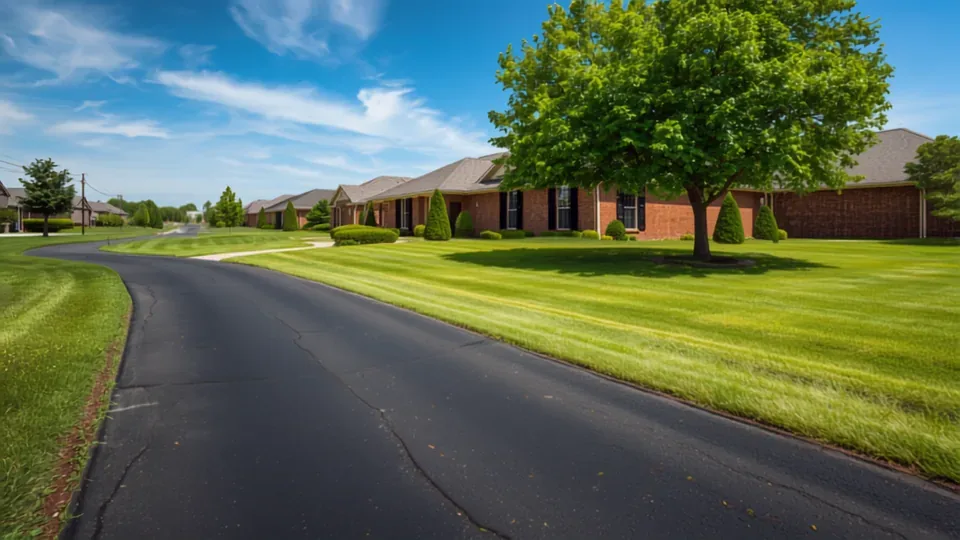
The older neighbourhoods and their oaks
In the Old Village and the established streets around it, the defining feature is the canopy. These are some of the most impressive live oaks in the region and they are sitting directly alongside driveways that were poured or paved decades ago.
Live oak roots travel shallow and spread laterally far beyond the branches. Under a driveway they lift, and the surface cracks along the root line. Homeowners in these neighbourhoods often describe the same experience — a section repaved a few years ago that has already opened up in exactly the same place. That is not poor workmanship on the repave. It is the root still being there.
What makes this awkward is that the tree usually outranks the driveway. Ordinances here restrict what may be done to a significant oak, and severing major roots can be both a violation and a slow death sentence for something irreplaceable. So the sequence runs the other way from what people expect: establish what the tree can legally and safely tolerate, then design the paving around that answer. Sometimes that means a physical divider set into a permitted cut. Sometimes it means the drive changes shape. Sometimes it means accepting a stretch of surface that will need attention every few years, and pricing that in.
The other feature of these older properties is the drive itself: often narrow, often original, sometimes an odd width because it was built for a smaller car. Widening is a common request, and the detail that matters is the joint where new meets old — a clean vertical cut on the existing edge rather than a feathered tie-in, sealed once cured.
The newer subdivisions north of the Isle of Palms Connector
The developments that filled in along Highway 17 and Rifle Range Road present an entirely different set of questions.
These are planned communities with homeowners associations, and a surprising number of them have something to say about driveway surfaces — the material, the colour, the extent of hardscape a lot may carry, and whether plans need approving before work starts. That is worth checking before getting quotes rather than after choosing one, because it can change what is being quoted.
The ground in much of this area was developed relatively recently, which cuts both ways. Newer subdivisions were built with engineered stormwater systems, which helps. But fill placed during development continues settling for years, and a driveway laid over ground still consolidating can develop dips that have nothing to do with the paving work.
Driveways here also tend to be longer and wider than in the older parts of town, which means more surface area, more drainage to think about, and a bigger difference between a bid quoting two inches and one quoting three.
Marsh edge, tidal creeks and the properties near them
Mount Pleasant has a great deal of marsh frontage, and properties near it have considerations that a lot two miles inland does not.
The ground softens as it approaches the marsh. Organic soils will not carry load, and a base built on them without correction will settle unevenly no matter how good the asphalt is. Sometimes the answer is undercutting and replacing material; sometimes it is accepting a shorter service life and pricing accordingly. What matters is that it gets discussed honestly at the estimate rather than discovered by the homeowner two winters later.
Tidal water reaches further up the creeks than most people expect, and a property that has never seen water in the street can still have brackish groundwater moving through the base. Salt is hard on granular base material and on metal in the drainage path. It does not rule out asphalt — it does mean the drainage design and the expected life should be discussed frankly.
For lots that take water during king tides or heavy storms, the useful conversation is about where the water goes when it leaves, not just about the slope of the driveway.
Sun, and the maintenance that actually matters
Mount Pleasant driveways get a lot of sun, and ultraviolet exposure is what ages an asphalt surface from the top down. It breaks down the binder holding the aggregate, the surface stiffens and greys, and eventually it starts releasing stone.
That process is slowed considerably by sealcoating on a sensible cycle — every two to three years, not annually. Applied too often the coating builds into a brittle film that cracks on its own, which is worse than leaving it alone.
Crack filling is the other half. Once a crack is wider than about a quarter of an inch it is an open route into the base, and given how much water this area sees, that matters more than the crack looks like it should.
Both are cheap relative to what they prevent, and both are the kind of thing that gets deferred until the driveway is past the point where they would have helped.
Getting the work done without losing the driveway for a week
Most residential drives here are a one-day job, occasionally two if there is meaningful base correction or the weather interrupts. What takes longer is getting back on it.
You can put a car back on within about two days. What follows is a long stretch — weeks, not hours — where the material still takes an impression, and a Mount Pleasant July extends that considerably beyond what a manufacturer is leaflet suggests. Through the first month, vary where you park, spread the load beneath anything resting on a single point, and get moving before you turn the wheel.
For households where a car genuinely cannot be off the drive, phasing is possible on wider driveways — half at a time — though it adds a joint and some cost. Worth asking about rather than assuming either way.
About the weather: neither soaked ground nor falling rain is workable, so a run of wet days pushes the appointment. That is not obstruction. A surface laid onto wet ground photographs beautifully on the day and gives up years early.
Request a free written quote
Tell us the address and what you are looking to have done. Ask for the quote in writing with the thickness and the base work spelled out, so you can compare bids on the same terms.
Prefer to talk it through? Call (843) 594-0781.
Mount Pleasant paving FAQ
Will my HOA need to approve a new driveway in Mount Pleasant? Often, in the newer communities. A number of associations here have requirements covering surface material, colour, the extent of hardscape on a lot, and whether plans need submitting before work begins. It is worth checking before collecting quotes, because a restriction can change what is being quoted. Older neighbourhoods generally have fewer of these, though work touching a public right of way has its own approval path regardless.
My driveway keeps cracking near a big oak. Can that be fixed permanently? Improved, yes. Permanently is a bigger claim, and it depends on what the tree will tolerate and what the ordinance permits. Something living is pushing that surface up, and laying fresh asphalt over it changes nothing about the thing doing the pushing — the line reappears, usually inside two summers. Genuine fixes involve either separating the root from the pavement, moving the pavement away from the root, or deciding to live with that stretch and maintain it. Which of those is on the table gets settled with the tree first.
Is asphalt a reasonable choice for a lot backing onto the marsh? Yes, with the design taking the ground seriously. Asphalt flexes rather than shattering when the ground moves, which suits soft and settling soils better than a rigid surface. What matters is what happens below — soft organic material generally needs correcting rather than paving over, and the drainage plan needs to account for water arriving from the marsh side as well as falling on the driveway.
How much does a driveway cost in Mount Pleasant? Not answerable from a phone call, and any figure offered that way will move once someone actually turns up. The items with real swing in them are how machinery reaches the work, whether something existing has to be broken out and carted off, how much of the ground beneath needs putting right, the finished depth, and what has to be constructed so runoff has somewhere to go. Drives in this part of town run bigger than the regional average, which lifts the total without necessarily lifting the rate.
Can you resurface instead of replacing? If the base is sound, yes, and it is good value when it applies. A surface that is grey, rough and showing surface cracking but has no dips, no soft spots and no standing water is usually a resurfacing candidate. Interconnected alligator cracking is the signal that the base has failed, and in that case a new layer on top will show the same pattern again within a couple of seasons.